
Best tax lien and deed data websites in 2026

Tax lien and tax deed investing lives or dies on data, and the data is a mess. Property taxes are administered at the county level, which means there are roughly 3,000 separate jurisdictions in the United States, each running its own auction calendar, its own delinquent list format, and its own website. Some counties post a clean Excel file. Others bury the list in a PDF newspaper notice, hand it off to a third-party auction vendor, or expect you to call the treasurer's office. There is no national feed, no standard schema, and no guarantee that last week's list still matches today's redemptions and removals.
That fragmentation is the core problem. To build a real pipeline of opportunities, you have to know which counties sell liens versus deeds, when each sale happens, where the list is published, and what every parcel is actually worth before you bid. Raw county data rarely tells you the assessed value, the use code, a mailing address, or whether a parcel is a buildable lot or a sliver of unusable land. You end up cross-referencing assessor portals, GIS maps, and Zillow by hand, parcel by parcel.
This guide compares the best places to find and research tax lien and tax deed data in 2026, from free county sources to paid aggregators and the auction platforms that run the sales. We evaluated each option on four criteria: coverage (states and counties reached), enrichment (whether it adds property data like values, addresses, and maps on top of raw lists), freshness (how current the data stays), and price. If you also want help acting on this data, see our guides to the best tax lien investing software and the best tax sale auction sites.
1. FastLien: best for enriched, all-in-one auction data
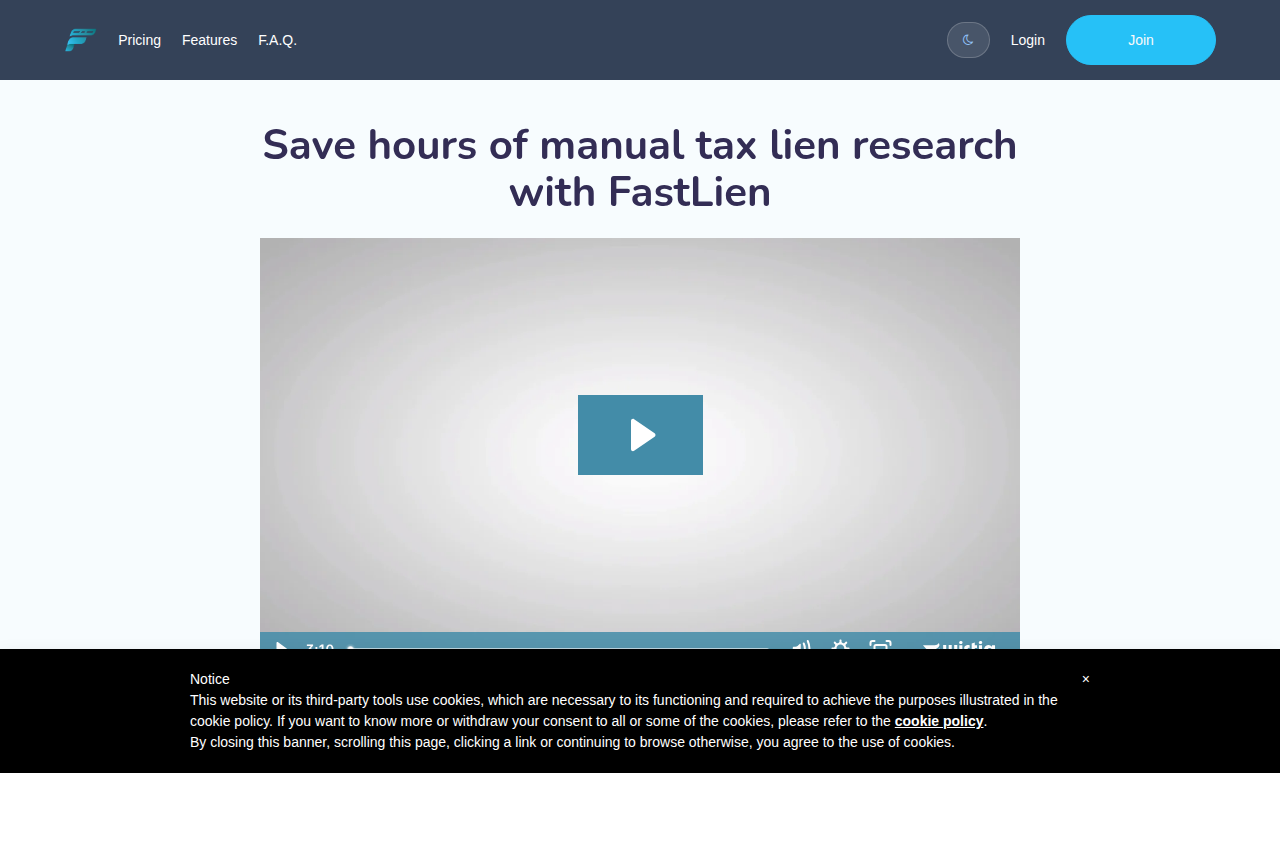
FastLien is built for exactly the problem above: it aggregates upcoming tax lien and tax deed auction lists from across all 50 US states and presents them in a single dashboard, with each parcel already enriched with property data. Instead of downloading a county PDF and then manually looking up what a parcel is worth, you get assessed values, use codes, addresses, and maps attached to the auction list directly. That turns hours of tab-juggling into a sortable, filterable view of what is actually coming to sale.
Beyond the data itself, FastLien adds portfolio tracking and forecasting tools so you can manage liens you already hold, and a Zillow integration to pull additional market context on a property without leaving the platform. It is positioned as a research and data layer rather than an auction house, so you use it to decide what to bid on and then go bid wherever the county actually runs its sale.
Key features and data: Upcoming tax lien and tax deed auction lists across all 50 states; enriched property data including assessed values, use codes, addresses, and maps; portfolio tracking; forecasting tools; Zillow integration; one centralized dashboard.
Pricing: $49 per month or $490 per year, flat, cancel anytime.
Pros: Truly national coverage in one place, enrichment baked into the lists so you skip the manual lookups, flat and transparent pricing that does not scale with portfolio size.
Cons: It is a data and research tool, not an auction platform, so you still place bids on the county or vendor system that runs each sale.
Best for: Investors who want enriched, centralized auction data instead of scraping county sites one by one.
Start with FastLien if centralized, enriched data is the bottleneck in your workflow.
2. County treasurer and tax collector websites: best free, primary source

The county treasurer or tax collector is the original source of every tax sale list. This is where delinquent lists are legally published, where redemption rules are set, and where the final, authoritative parcel data lives. Everything the aggregators sell ultimately traces back here. If you want to verify a parcel, confirm a sale date, or read the exact statutory redemption period for a jurisdiction, the county is the canonical answer and it costs nothing.
The catch is fragmentation. There is no national directory, formats vary wildly from clean spreadsheets to scanned PDFs, and you have to visit each county individually. The National Association of County Treasurers and Finance Officers (NACTR) is a useful starting point for finding offices, but there is no unified data feed. This is the free, honest baseline that every paid tool is competing against on convenience.
Key features and data: Authoritative delinquent and tax sale lists, official redemption rules, assessor and GIS portals, sale dates and terms straight from the source.
Pricing: Free.
Pros: No cost, fully authoritative, the definitive place to confirm redemption rules and parcel details.
Cons: Scattered across roughly 3,000 jurisdictions, inconsistent formats, no enrichment, heavy manual effort to assemble a national or even multi-county view.
Best for: Verifying specifics and investors focused on one or two local counties they can monitor by hand.
3. Tax Sale Resources: best for deep nationwide research tiers
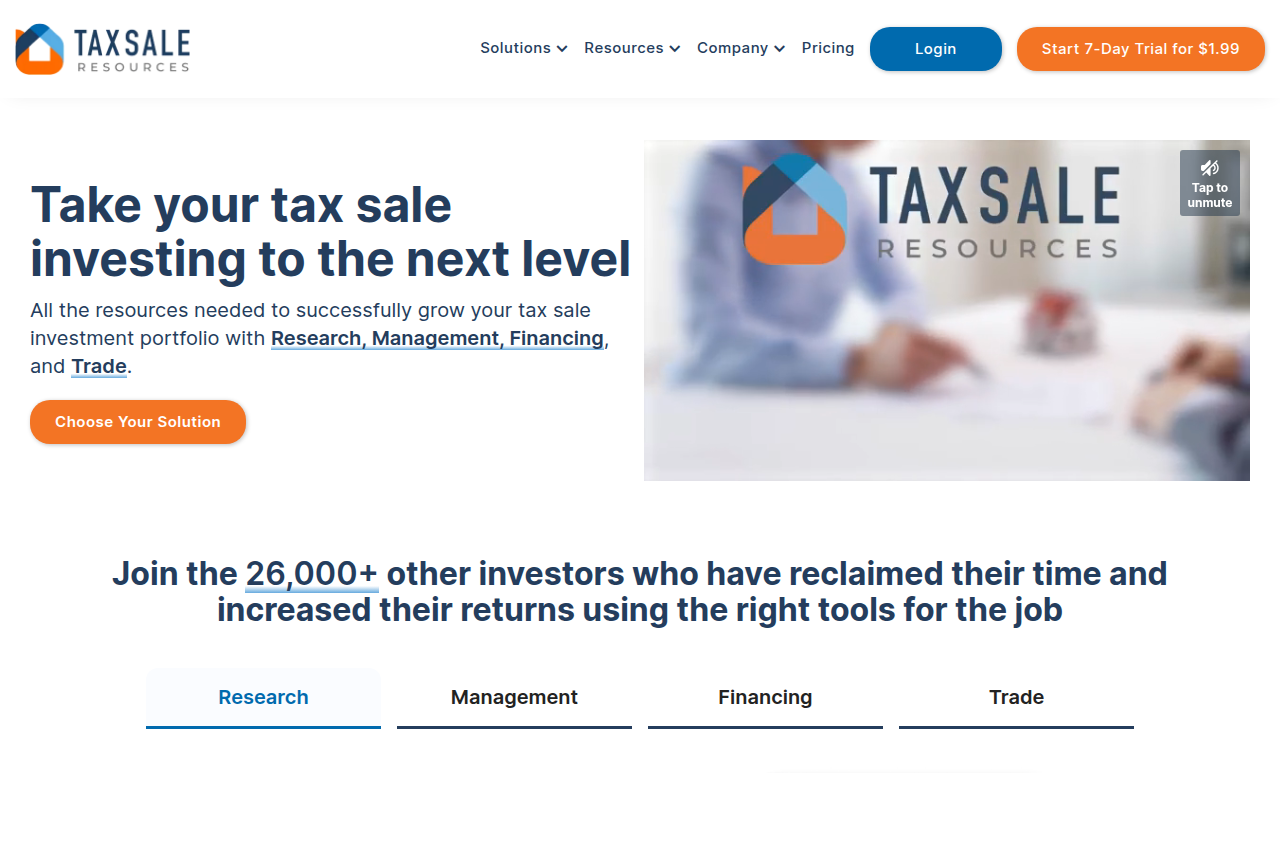
Tax Sale Resources is one of the most established nationwide data providers in the space, offering research, management, and financing products aimed at serious and full-time investors. The research product collects tax sale lists nationwide, including over-the-counter (OTC) inventory updated monthly, and lets you download standardized parcel spreadsheets rather than chasing each county's format. Data onboarding, training, and support are included with the subscription.
It is a more enterprise-leaning platform, with multiple tiers that climb steeply as you move from hobbyist to full-time investor, plus a separate management product priced on assets under management. That depth is valuable if you operate at scale, though the higher tiers get expensive fast.
Key features and data: Nationwide tax sale and OTC lists, standardized downloadable spreadsheets, monthly OTC updates, plus separate management and financing solutions.
Pricing: Research plans run Standard at $97 per month ($582 per year), Pro at $147 per month ($882 per year), and Premier at $497 per month ($4,970 per year), with Enterprise quoted on request. The management product starts around $1,000 per month. No commitments, cancel anytime.
Pros: Broad nationwide coverage, OTC inventory, standardized data exports, strong support and training, options for organizations.
Cons: Pricing climbs quickly into the hundreds or thousands per month, more than many individual researchers need.
Best for: Full-time and institutional investors who want deep nationwide research and are comfortable with higher-tier pricing.
4. Parcel Fair: best for map-based property research
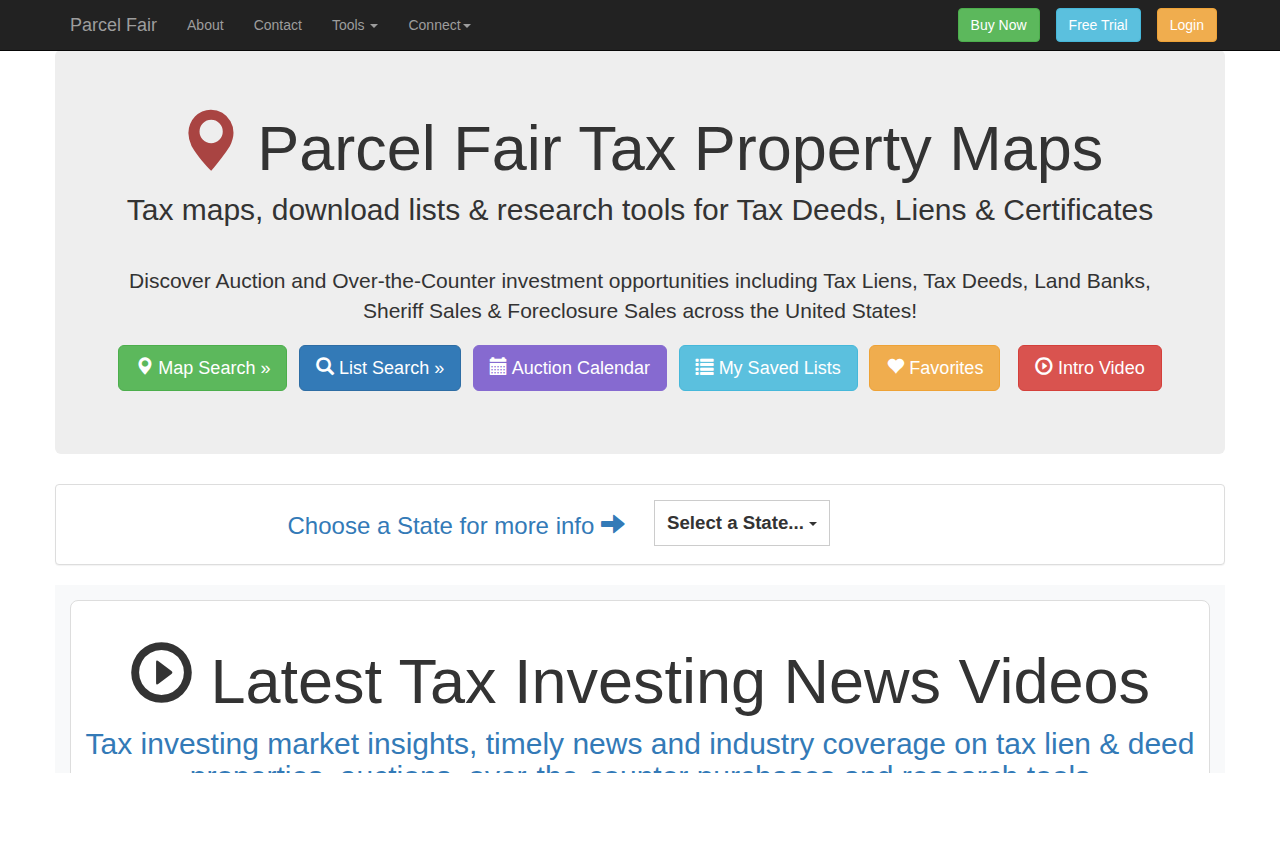
Parcel Fair takes a visual, map-first approach to tax-delinquent property research. The platform tracks roughly 589,000 active parcels and more than 2.7 million historical properties across about 3,147 counties, and lets you browse them on an interactive map with satellite and street-level imagery, several years of historical inventory, and an auction calendar to track upcoming sale dates.
If your research style is geographic, looking at where a parcel sits, what surrounds it, and whether it is a usable lot, Parcel Fair's mapping is its strongest feature. Pricing is reasonable, though it is not always clearly displayed on the site, so it can be unclear whether you are seeing the promotional or the regular rate.
Key features and data: Interactive map search, satellite and street-level imagery, up to several years of historical inventory, multi-county auction calendar, broad county coverage.
Pricing: Roughly $55 per month ($550 per year) at the promotional rate and $65 per month ($650 per year) at the regular rate, with a 7-day free trial and no credit card required.
Pros: Strong map-based research, wide county footprint, generous historical data, free trial.
Cons: Pricing presentation can be confusing (promotional versus regular), and the experience is built around browsing rather than enriched, ready-to-sort national lists.
Best for: Investors who research visually and want to evaluate parcels on a map before bidding.
5. RealAuction (RealTaxLien): best for accessing online county sales

RealAuction is one of the largest online auction vendors that counties hire to actually run their tax sales. Through products like RealTaxLien (lien certificate sales) and RealTDA (tax deed applications), it powers annual tax lien sales, county-held and state-owned sales, foreclosure auctions, and sheriff sales. Founded in 2004, it reports having conducted over 1.5 million online auctions.
For data purposes, what matters is that bidder-facing features including raw data downloads, file transfers, certificate history, property information, and maps are free to all registered bidders on the platform. So while RealAuction is primarily an auction host, it is also a legitimate (and free) place to pull parcel data for the counties it serves, which it describes as spanning 11 states.
Key features and data: Online lien, deed, foreclosure, and sheriff sale auctions; free bidder access to raw data, certificate history, property info, and maps; step-by-step registration with electronic W-9.
Pricing: Free to register and access bidder data; counties may set their own deposit or registration requirements.
Pros: Free data access for served counties, official auction platform so the data matches the actual sale, long track record.
Cons: Coverage limited to the counties and states (around 11) that contract with RealAuction; data is per-county, not a national aggregate.
Best for: Investors bidding in RealAuction counties who want official lists and parcel data at no cost.
6. GovEase: best for accessing southern and western county sales
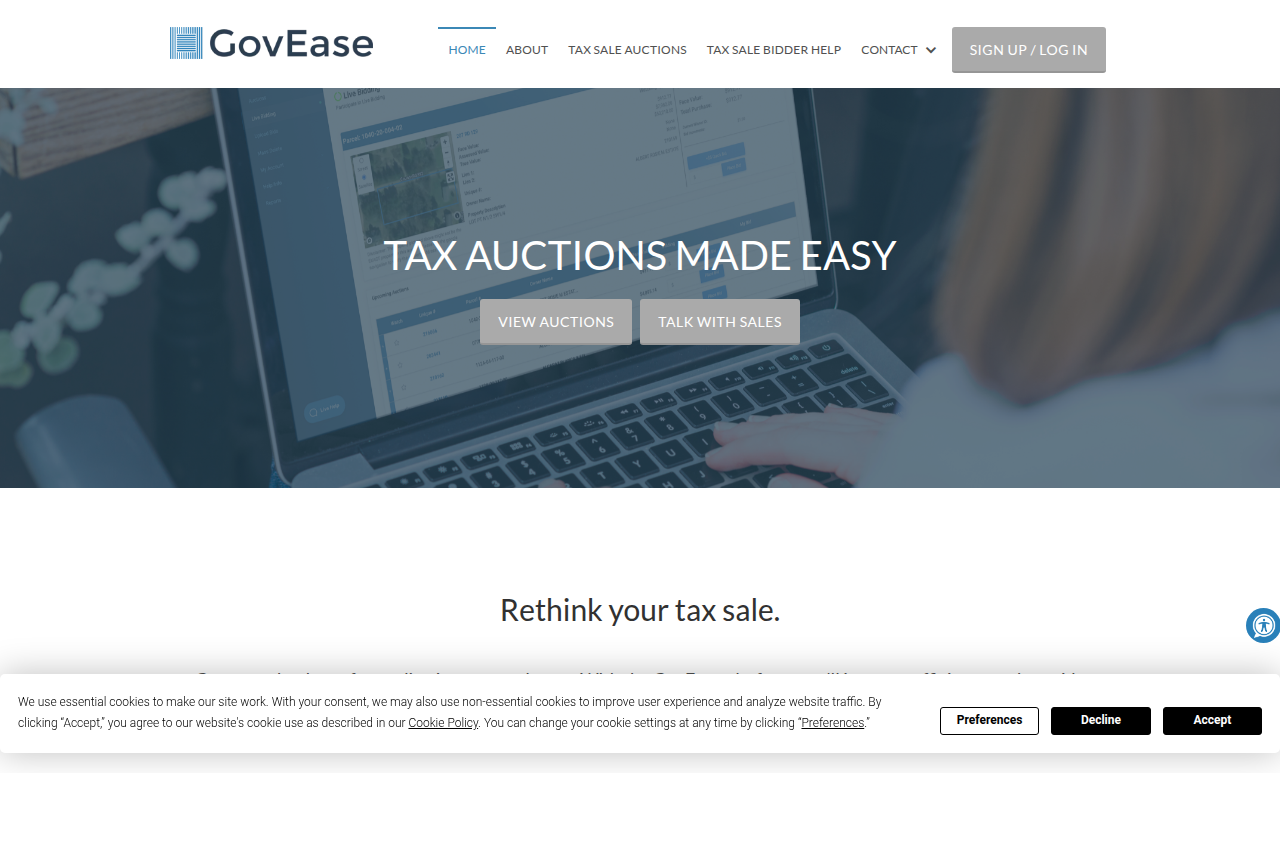
GovEase is another major online auction platform that counties use to run tax lien and tax deed sales, with strong presence in states like Alabama, Mississippi, and across the South and West. Creating an account is free, and the platform publishes live and upcoming tax sale auction listings you can browse to see what is coming to sale and where.
Like RealAuction, GovEase is the official sale venue for its counties rather than a standalone data product, but the public auction listings make it a useful place to track inventory in the jurisdictions it serves. Fees, when they exist, are set by the individual county.
Key features and data: Live and upcoming tax sale auction listings, per-county sale details and terms, online bidding for liens and deeds.
Pricing: Free to create an account; some counties charge a non-refundable registration fee (commonly around $35) and may require a refundable deposit set by the county.
Pros: Free account and browsable auction calendar, official platform so listings are accurate, strong coverage in southern and western states.
Cons: Listings limited to GovEase counties, county-set fees and deposits vary widely, not a national enriched dataset.
Best for: Investors targeting counties that run their sales on GovEase.
7. Grant Street Group (LienHub): best for Florida tax certificate data
Grant Street Group runs LienHub, the official online portal for tax certificate sales and management in a large share of Florida counties. Grant Street's broader TaxSys platform is used to collect a substantial portion of Florida property taxes, and counties such as Broward, Pinellas, Seminole, and Orange use its auction tools to sell certificates online.
For Florida lien investors, LienHub is effectively the source. It is where you register, research the items in an auction, submit bids, view results, file tax deed applications, and access tax reporting documents for participating counties. If Florida is your market, this is the authoritative platform to find and research certificate data.
Key features and data: Florida tax certificate auctions, certificate research and status, tax deed application filing, bidding and results, county tax reporting documents.
Pricing: Free to register and research; bidding mechanics and any county fees follow each county's rules.
Pros: Authoritative for participating Florida counties, integrated research-to-bid-to-deed workflow, official certificate status and reporting.
Cons: Florida-focused, so not useful outside the counties it serves; built around its own counties rather than a national view.
Best for: Florida tax lien certificate investors who want official, county-source data.
8. SRI Inc: best for Indiana and Midwest tax sale data
SRI Incorporated, based in Indianapolis, administers tax and certificate sales for a large number of Indiana counties and runs its online sales through zeusauction.com. A single registration at sriservices.com is good across all the counties SRI services, which removes a lot of the per-county friction for investors working that region.
SRI also publishes practical guidance on the tax sale process, including Indiana's standard one-year redemption period for real property sold at county tax sale. For investors concentrated in Indiana and nearby Midwest jurisdictions, SRI is the practical hub for finding sale dates, lists, and rules.
Key features and data: Indiana county tax sale administration, online sales via zeusauction.com, single multi-county registration, sale schedules, and process and redemption guidance.
Pricing: Free to register; county and statutory fees apply at sale.
Pros: Central hub for many Indiana counties, one registration covers all serviced counties, clear process documentation including redemption periods.
Cons: Regionally focused on Indiana and the Midwest, not a national dataset, primarily an administration and auction service rather than an enrichment tool.
Best for: Investors focused on Indiana and Midwest county tax sales.
9. Bid4Assets: best for California and tax-defaulted deed auctions
Bid4Assets is a long-running online marketplace for government property auctions, widely used by counties for tax-defaulted (deed) sales, including large jurisdictions like Los Angeles County and Clark County, Nevada, as well as sheriff sales. Accounts are free, and the public storefronts show upcoming and active county auctions you can research before deciding to bid.
It is most associated with tax deed and tax-defaulted property sales rather than lien certificates. Deposits are required per county (typically refunded minus a processing fee, commonly $35), and winning bidders can use the platform's Deed Wizard to handle vesting and transfer.
Key features and data: Online county tax-defaulted and deed auctions, sheriff sales, public auction storefronts with property listings, Deed Wizard for deed transfer.
Pricing: Free account; per-county refundable deposit required to bid (refunds typically minus a $35 processing fee), with county-specific terms.
Pros: Established platform for tax deed sales, covers major counties, free to browse listings, streamlined deed transfer tools.
Cons: Deed-focused rather than lien certificates, per-county deposits, data limited to participating counties.
Best for: Investors pursuing tax deed and tax-defaulted property auctions, especially in California and Nevada.
Comparison table
| Source | Best for | Starting price |
|---|---|---|
| FastLien | Enriched, all-in-one national auction data | $49/month or $490/year |
| County treasurer / tax collector sites | Free, authoritative primary source | Free |
| Tax Sale Resources | Deep nationwide research tiers | $97/month (research, Standard) |
| Parcel Fair | Map-based property research | $55/month (promotional) |
| RealAuction (RealTaxLien) | Accessing online county sales | Free bidder data access |
| GovEase | Southern and western county sales | Free account (county fees vary) |
| Grant Street Group (LienHub) | Florida tax certificate data | Free to register and research |
| SRI Inc | Indiana and Midwest tax sale data | Free to register |
| Bid4Assets | California and tax-defaulted deed auctions | Free account (per-county deposit) |
Frequently asked questions
Are county tax sale lists really free? Yes. County treasurer and tax collector offices publish delinquent and tax sale lists at no cost, and they are the authoritative source for sale dates and redemption rules. The trade-off is fragmentation: lists are spread across roughly 3,000 jurisdictions in inconsistent formats with no enrichment, so assembling a multi-county or national view by hand is slow.
What is the difference between a data aggregator and an auction platform? A data aggregator like FastLien, Tax Sale Resources, or Parcel Fair collects and enriches lists from many jurisdictions so you can research what is coming to sale in one place. An auction platform like RealAuction, GovEase, LienHub, SRI, or Bid4Assets is hired by counties to actually run the sale, so it is where you register and bid. Many investors use an aggregator to decide what to pursue and an auction platform to execute.
Why does enriched property data matter? Raw county lists usually give you a parcel number and an amount owed, but not the assessed value, use code, address, or location context you need to judge whether a parcel is worth bidding on. Enriched data attaches those details so you can sort and filter opportunities instead of looking up each parcel individually across assessor portals and mapping sites.
Where do I confirm redemption rules? Redemption periods and procedures are set by state statute and administered by the county, so the county treasurer or tax collector and your state statutes are the authoritative places to confirm them. Aggregators and auction vendors often summarize the rules (for example, SRI notes Indiana's one-year redemption period), but verify the specifics against the official county or state source before you commit capital.
If the real bottleneck in your tax lien and deed research is stitching together scattered county lists and then enriching every parcel by hand, a centralized data layer pays for itself quickly. FastLien brings national auction lists and enriched property data into one dashboard so you can spend your time deciding what to bid on, not hunting for the data.