
Best tax sale auction sites in 2026

A decade ago, buying a tax lien or tax deed meant showing up at a county courthouse on a specific morning, bidding card in hand. That has largely disappeared. As of 2026, the overwhelming majority of US tax sales run online, and they run on a surprisingly small handful of auction platforms. There is no single national marketplace. Instead, each county picks a vendor that handles registration, deposits, bidding, and payment for that county's sale.
This shapes how you actually invest. Florida tax certificates tend to run on LienHub or RealAuction. Alabama and Mississippi tax liens usually go through GovEase. Indiana and Colorado route many sales through SRI's Zeus Auction. California and Nevada tax-defaulted auctions tend to land on Bid4Assets. The platform is not really a choice you make: it is dictated by the county you want to buy in. Your job is to know which platform runs which sales, register early, and fund the right deposit before bidding opens.
When evaluating where to spend your time, focus on four things: coverage (which states and counties the platform runs), the deposit and fee structure (most charge a small non-refundable registration fee plus a refundable bid deposit), the bidding mechanics (proxy bidding, interest-rate bid-downs, premium bids), and whether you can get the property data you need to bid responsibly. That last point is where new investors get burned: the auction platforms are built to run sales, not to help you research parcels. That is the gap the first tool fills.
1. FastLien: best for researching before you bid
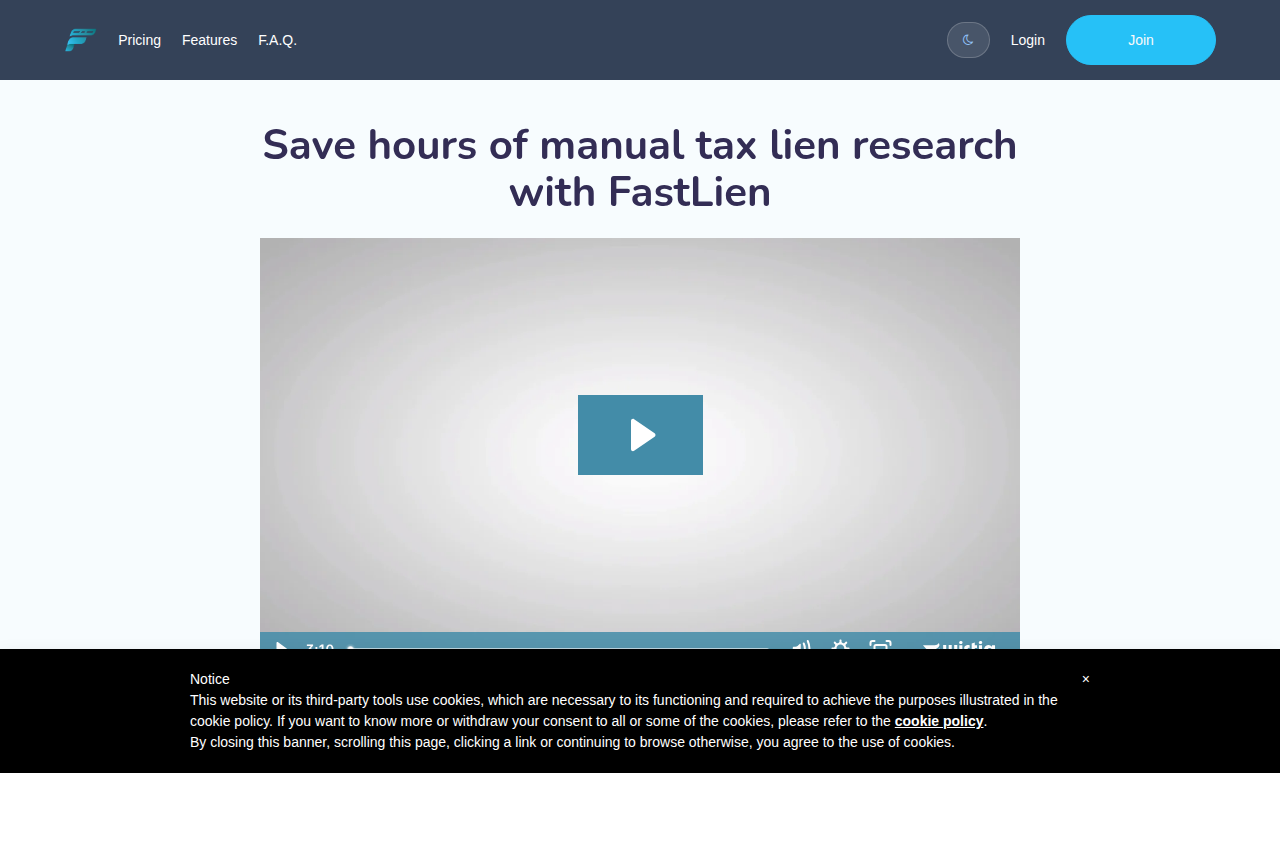
Let's be clear up front: FastLien is not an auction site. You cannot place a bid on FastLien, and it does not host county sales. It is the research and data layer you use alongside the auction platforms below: the workbench where you decide what to bid on, then go execute that bid on Bid4Assets, GovEase, RealAuction, or wherever the county runs its sale.
FastLien aggregates upcoming tax lien and tax deed sale lists across all 50 states and enriches each parcel with the data you need to value it: assessed values, land use codes, property addresses, and maps. It also includes portfolio tracking and forecasting tools, plus a Zillow integration to check market value against the assessment. The point is to do due diligence and track deals before and after you bid, rather than scrambling through a county PDF the night before a sale.
Key features:
- Aggregated upcoming tax lien and tax deed sale lists across all 50 states
- Enriched property data: assessed values, use codes, addresses, and maps
- Zillow integration for market-value context
- Portfolio tracking and forecasting tools to manage liens and deeds after purchase
Costs/fees: Flat pricing at $49 per month or $490 per year. No per-parcel or per-sale charges.
Pros:
- Nationwide coverage, so you research every state from one place instead of hopping between county sites
- Built specifically for due diligence, which the auction platforms are not
- Predictable flat cost
- Useful both before bidding (vetting parcels) and after (tracking your portfolio)
Cons:
- It is not a marketplace: you still place actual bids on the county's auction platform
- A subscription cost on top of the deposits and fees the auction sites charge
Best for: Investors who want to vet parcels, compare values, and track a portfolio across states, then bid smarter on the marketplaces below. See also our guides to the best tax lien investing software and the best tax lien and deed data websites.
2. Bid4Assets: best for California and Nevada tax-defaulted property
Founded in 1999, Bid4Assets is one of the oldest online government auction marketplaces in the country. It hosts county tax-defaulted (tax deed) auctions, sheriff's sales, and federal forfeiture auctions. It is especially strong in California tax-defaulted property sales, and also runs sales for counties in Nevada, Pennsylvania, and Washington. The active county list shifts through the year as counties schedule their auctions.
Key features:
- Long-running marketplace for county tax-defaulted property, sheriff's, and forfeiture auctions
- Strong California county coverage plus Nevada, Pennsylvania, and Washington
- Per-county auction storefronts with property lists and terms
Costs/fees: Bidders place a refundable bid deposit before bidding, with the amount set by each county (examples have included $500 to $2,500). A non-refundable processing fee, commonly $35, applies. Refunds are typically returned via eCheck.
Pros:
- Deep, established inventory of tax-defaulted real estate
- Clear per-county terms and a familiar bidding interface
- Good fit if your target is California or Nevada deed sales
Cons:
- Deposit amounts and rules vary county to county, so read each storefront carefully
- Tax deed focused, so not the place for tax lien certificates
Best for: Investors targeting tax-defaulted real estate (deeds) in the western US, especially California and Nevada.
3. RealAuction: best for Florida and multi-state county sales

RealAuction, founded in 2004, runs one of the largest networks of government auctions in the country and reports having conducted well over 1.5 million online auctions. It operates as a family of branded products: RealTaxLien for delinquent tax lien certificate sales, RealForeclose for foreclosure, tax deed, and sheriff sale auctions, and RealTDA and RealTDM for tax deed application and management. Counties typically run RealAuction sales on their own subdomains (a pasco.realtaxdeed.com style portal). Coverage spans multiple states, with heavy use in Florida along with Maryland, New Jersey, and Arizona.
Key features:
- Separate products for tax liens (RealTaxLien) and tax deeds and foreclosures (RealForeclose)
- Proxy bidding: you enter a maximum and the system bids on your behalf in set increments
- Per-county portals with property lists, bidding instructions, and deposit handling
Costs/fees: Bidders fund a refundable deposit via wire or electronic check (ACH); ACH typically needs several business days to clear before the sale. On Florida tax deed sales, the deposit on a winning bid is commonly the greater of $200 or 5% of the bid, with the balance due by noon the next business day. Amounts and timelines are set by each county.
Pros:
- Broadest footprint for Florida tax certificate and tax deed sales
- Handles both liens and deeds, so you can stay on one platform across sale types in covered counties
- Mature proxy bidding system
Cons:
- ACH funding lead time means you cannot fund a deposit at the last minute
- The county-subdomain model means you register separately for many individual portals
Best for: Florida investors and anyone buying liens or deeds across RealAuction's multi-state county network.
4. GovEase: best for Alabama, Mississippi, and Tennessee tax sales
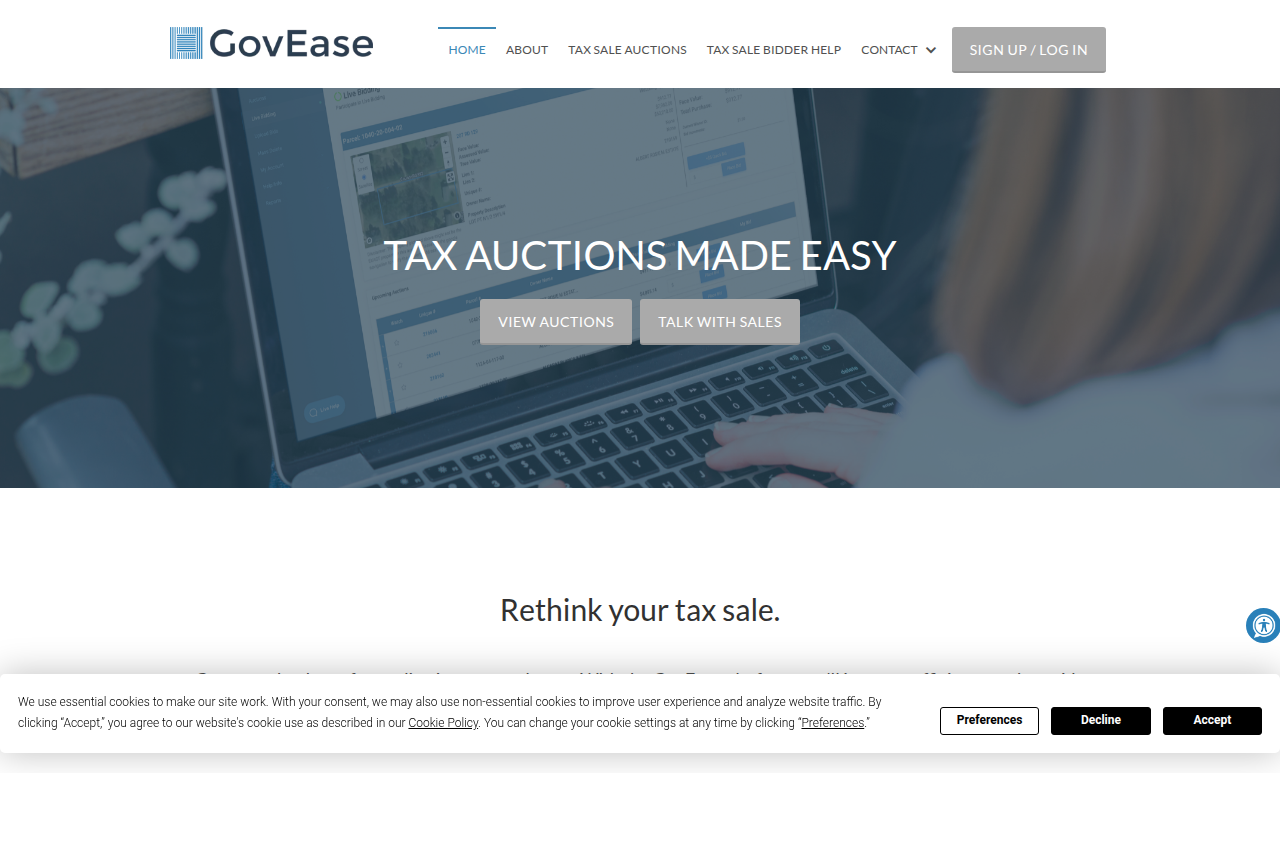
GovEase is a modern online auction platform focused specifically on tax lien and tax deed sales, and it has become the dominant vendor for several Deep South states. It runs auctions for many counties in Alabama and Mississippi, has a presence in Tennessee, and also powers large California tax-defaulted sales such as Los Angeles County. Alabama sales on GovEase use an interest-rate bid-down format, where bidders compete by accepting a lower annual interest rate.
Key features:
- Purpose-built for tax liens and tax deeds with state-specific training and support
- Interest-rate bid-down for Alabama tax lien auctions
- State-by-state help resources and live customer support
Costs/fees: Registration is free, but each sale requires a refundable bid deposit (often a percentage of your intended spend, such as 10%) plus a small non-refundable registration fee set by the county (examples have included $35 to $40). Some counties add a buyer's premium. Refunds are typically processed within 7 to 10 business days after the sale.
Pros:
- Clean, intuitive interface built specifically for tax sales
- Strong support and per-state training materials for first-time bidders
- The go-to platform for Alabama and Mississippi liens
Cons:
- Deposit and premium rules vary by county, so total cost to participate is not uniform
- Coverage is concentrated, so it will not cover every state you might target
Best for: Investors buying tax liens in Alabama and Mississippi, or large California deed sales.
5. LienHub by Grant Street Group: best for Florida tax certificate sales
Grant Street Group, based in Pittsburgh, has run online tax certificate sales for Florida counties for years (earlier branded LienAuction, now LienHub). It is built around Florida's annual tax certificate sale cycle, where counties sell certificates on delinquent parcels and bidders compete by bidding down the interest rate. Florida counties that have used Grant Street's platform include Miami-Dade, Broward, Palm Beach, Orange, Osceola, Lake, Leon, Marion, Volusia, and St. Lucie, with historical usage in Maryland and Arizona.
Key features:
- Specialized platform for Florida annual tax certificate (tax lien) sales
- Interest-rate bid-down format standard to Florida certificate auctions
- Also supports ongoing sales of county-held certificates between annual sales
Costs/fees: Bidders register and fund deposits through the platform; deposit requirements and fees are set by each county tax collector. Florida certificate sales follow the annual cycle, with property lists typically posted in May and bidding closing on or before June 1.
Pros:
- Deep specialization in the high-volume Florida certificate market
- Handles both annual sales and county-held certificate purchases
- Well understood by experienced Florida lien buyers
Cons:
- Narrow focus: built around Florida certificates rather than broad national coverage
- The annual calendar means timing is tight and compressed into early summer
Best for: Investors focused on Florida tax lien certificates, including county-held certificate purchases.
6. SRI / Zeus Auction: best for Indiana and Colorado tax sales
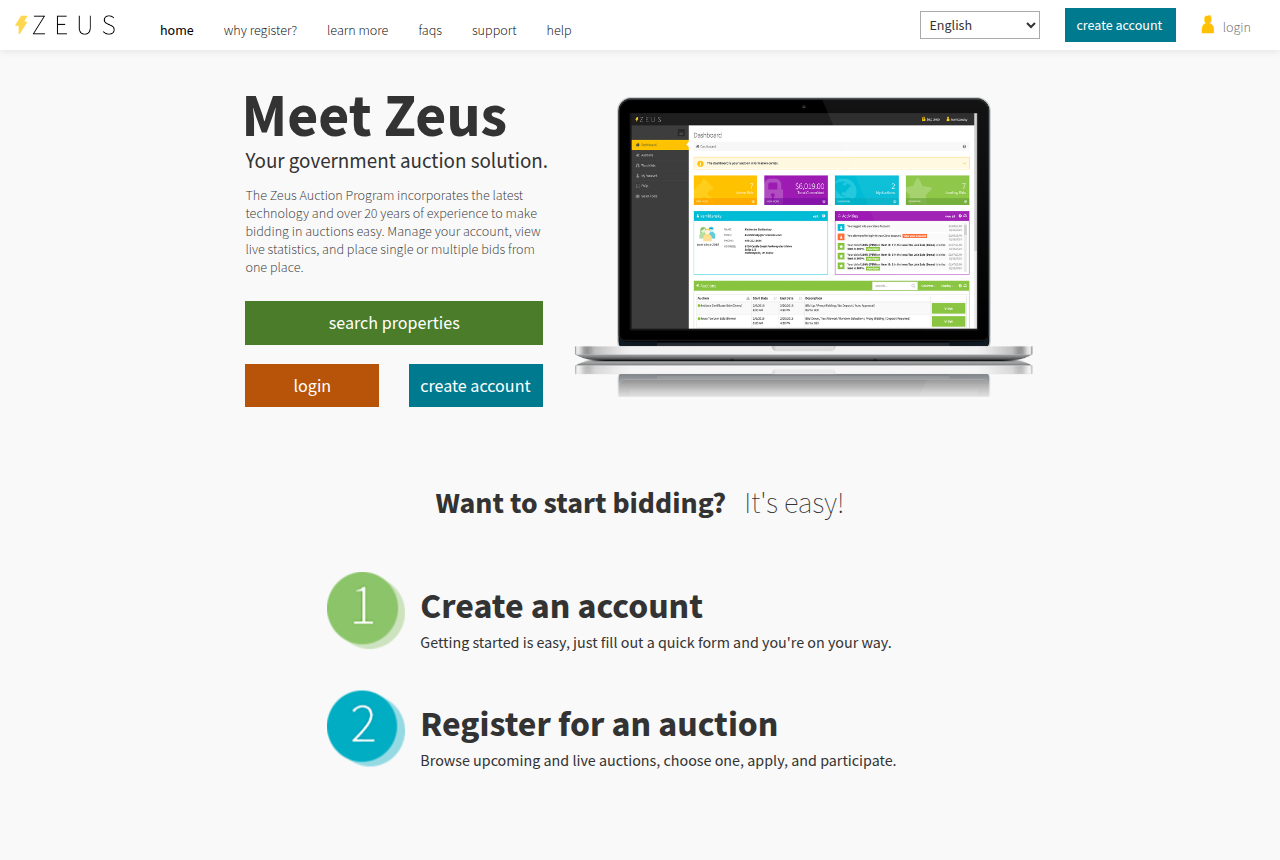
SRI Incorporated, based in Indianapolis, administers online tax sales through its Zeus Auction platform. Zeus is the standard vehicle for Indiana county tax sales (and sheriff's mortgage foreclosure sales), and it runs Colorado tax lien sales for counties such as Jefferson and Douglas. SRI's reported coverage also extends to Iowa, Louisiana, Tennessee, and Florida. Payment for liens purchased through Zeus is by ACH only.
Key features:
- Online tax lien and tax sale administration across Indiana, Colorado, and additional states
- Handles Indiana tax sales plus sheriff's mortgage foreclosure sales
- ACH-only payment for purchased liens
Costs/fees: Bidders register at zeusauction.com before the sale and complete required paperwork, including an IRS W-9 and bank information for ACH. Deposit and registration specifics are set by each county and sale.
Pros:
- The default platform for Indiana tax sales, with strong Colorado coverage
- Long track record administering government sales
- Clear registration and W-9 process
Cons:
- Interface is more utilitarian than newer platforms
- ACH-only payment requires advance bank setup
Best for: Investors targeting Indiana and Colorado tax liens, plus SRI's other covered states.
7. County-run and clerk portals: best when there is no third-party vendor

Not every sale runs on a national vendor. In Florida, tax deed sales are run by each county's clerk of court: many use RealAuction-powered portals, while others operate their own systems or smaller regional vendors. Always confirm where a county actually runs its sale rather than assuming a national marketplace.
Key features:
- Direct county or clerk-operated auction systems for tax deeds and, in some places, liens
- Property lists, terms, and deposit instructions published per county
- Often the authoritative source for that county's specific rules
Costs/fees: Set entirely by the individual county or clerk. Deposits are commonly a percentage of the bid (5% to 10% is typical for deed sales), with the balance due within a short window after the sale, sometimes as little as 24 hours.
Pros:
- The definitive source for that county's sale, with no intermediary
- Rules and terms come straight from the office running the sale
Cons:
- Fragmented: every county system looks and behaves differently
- Registration and deposit processes are not standardized
Best for: Buyers targeting a specific county whose sale is not on a national platform, especially Florida tax deeds run through clerk portals.
Comparison table
| Platform | Coverage | Cost to use |
|---|---|---|
| FastLien | Research layer, all 50 states (not an auction site) | $49/month or $490/year flat |
| Bid4Assets | CA, NV, PA, WA county tax-defaulted property and more | Refundable county deposit + ~$35 processing fee |
| RealAuction | FL, MD, NJ, AZ and other multi-state county liens and deeds | Refundable deposit via wire/ACH; county-set amounts |
| GovEase | AL, MS, TN liens; large CA deed sales | Free registration + refundable deposit + small county fee |
| LienHub (Grant Street) | FL tax certificates (Miami-Dade, Broward, Palm Beach, etc.) | County-set deposits and fees |
| SRI / Zeus Auction | IN, CO liens plus IA, LA, TN, FL | County-set deposit; ACH-only payment, W-9 required |
| County / clerk portals | Specific counties without a national vendor (many FL deeds) | County-set deposit, often 5% to 10% of bid |
Frequently asked questions
Is there one website where all US tax sales happen? No. Each county chooses an auction vendor, so the same investor might use Bid4Assets for a California deed, GovEase for an Alabama lien, and RealAuction for a Florida certificate. Start with the county you want to buy in, then find the platform it uses.
Do these auction platforms charge investors to bid? Most charge a small non-refundable registration or processing fee (commonly $35 to $40) plus a refundable bid deposit set by the county. The deposit is returned if you do not win, or applied to your purchase if you do. Amounts and refund timelines vary by sale, so read the terms.
What is the difference between a tax lien and a tax deed sale? In a tax lien sale you buy a certificate against the delinquent taxes and earn interest until the owner redeems (Florida, Alabama, Indiana). In a tax deed sale you bid to acquire the property itself (common in California and many Florida clerk sales). Check which type a county runs before you register.
Where does FastLien fit if it is not an auction site? FastLien is the research step before and after the auction. You use it to find upcoming sales nationwide, value parcels with assessed values, use codes, maps, and a Zillow check, then track what you buy. You still place bids on the platforms above. FastLien helps you decide what to bid on and at what price.
Ready to bid smarter?
Pick the right marketplace for your target county, then do the homework before the gavel falls. FastLien gives you nationwide sale lists and enriched property data for $49/month, so you walk into every auction already knowing what each parcel is worth.